Search National Knives Blog

Wednesday, November 30, 2011

What a Steel! A look at Carpenter Technology Corporation.

In the late 1800s, James Carpenter received a patent for a tool steel that was air-hardened.  At that point in history, James Carpenter's industrial complex amounted to just one building in Pennsylvania.  This was the beginning of what would be known today as Carpenter Technology Corporation, a producer of a wide array of steels along with other metallurgical products.

Carpenter Technology Corporation produces a wide array of products that surround us in our day to day lives.  In the car you drive, the plane you fly, from the doctor's office to outer space, chances are you have encountered their products without even knowing about it.  Unlike the cars and planes that are branded with the manufacturers name and logo, Carpenter and other industry suppliers don't often get the opportunity to brand their products, at least not in a fashion that would be recognizable to most of us.  The premium knife industry understands that the type of steel used to make the blade of the knife is very important to the end user (you and me).  With this in mind, knife manufacturers have been labeling the blades of their knives with the type of steel used to produce it.  This bit of information helps those of us that have a steel fixation (also known as "Steel Junkies") to better choose the knife that is most appropriate for the task at hand. 

CTS™ XHP
  • Offers grindability, edge retention and corrosion resistance comparable to 440C stainless steel.
  • Contains 1.60% Carbon, 0.40% Silicon, 0.35% Nickel, 0.45% Vanadium, 0.50% Manganese, 16.00% Chromium, 0.80% Molybdenum.
  • Ideal hardness (HRc) is between 60 - 64.
  • Can be compared to a corrosion resistant D2 tool steel or a high hardness (HRc) 440C stainless steel.
  • Can be polished or left in a matte finish.


Spyderco Military, Plain 4" CTS-XHP Blade, Brown G-10 Handle Sprint Run C36GPBNXHP
CTS™ BD1
  • Offers high hardness and wear resistance
  • Contains 0.85% - 0.95% Carbon, 0.040% Phosphorous, 1.00% Silicon, 0.50% Molybdenum, 1.00% Manganese, 0.030% Sulfur, 15.00% - 17.00% Chromium.
  • Ideal hardness (HRc) is between 58 - 60.
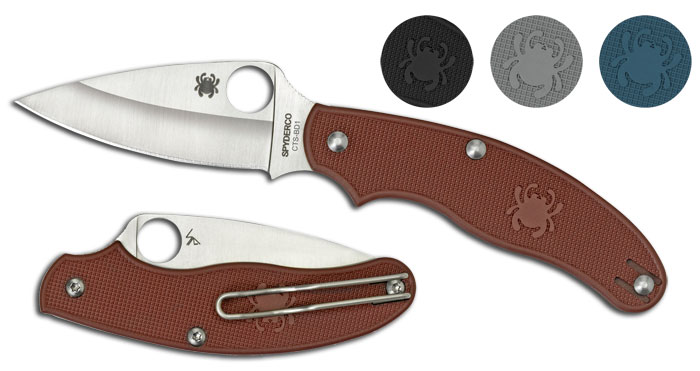
Spyderco UK Penknife, CTS-BD1 Stainless Steel Blade, FRN Handle C94FRN
CTS™ 204P
  • Offers high wear resistance and high corrosion resistance.
  • Contains 1.90% Carbon, 0.60% Silicon, 1.00% Molybdenum, 0.65% Tungsten, 0.35% Manganese, 20.00% Chromium, 4.00% Vanadium.
  • Ideal hardness (HRc) is between 57 - 63.
CTS™ 40CP
  • Offers high hardness.
  • Contains 0.95% - 1.20% Carbon, 0.040% Phosphorous, 1.00% Silicon, 0.75% Molybdenum, 1.00% Manganese, 0.030% Sulfur, 16.00% - 18.00% Chromium.
  • Ideal hardness (HRc) is between 60 - 62.
CTS™ 20CP (Micro-Melt­® 420 CW)
  • Offers high wear resistance and high corrosion resistance
  • Contains 2.25% Carbon, 0.030% Sulfur, 12.80% Chromium, 9.25% Vanadium, 0.50% Manganese, 0.90% Silicon, 1.30% Molybdenum.
  • Ideal hardness (HRc) 56 - 60.
  • Compared to Crucible Industries CPM® S90V
Spyderco ParaMilitary 2, Plain Edge CTS-20CP Blade, Gray G-10 Handle, Sprint Run, C81GGY20CP2
CTS™ TMT (Trinamet® Stainless)
  • Offers excellent corrosion resistance.
  • Contains 0.30% Carbon, 0.040% Phosphorous, 1.00% Silicon, 1.00% - 3.00% Molybdenum, 1.00% Manganese, 0.030% Sulfur, 12.00% - 14.00% Chromium, 2.00% - 3.00% Copper
  • Ideal hardness (HRc) 49 - 53.
CTS­­™ 10 (410 Stainless)
  • Offers good corrosion resistance.
  • Contains 0.15% Carbon, 0.040% Phosphorous, 1.00% Silicon, 1.00% Manganese, 0.030% Sulfur, 11.50% - 13.50% Chromium.
  • Often used in creating a Damascus style pattern (laminate) on knife blade.
 
Al Mar Ultra Chef, Plain VG-10 Stainless Steel Blade with 410 Stainless Steel Layers (33 per side) and 410 Stainless Steel Handle SC8

CTS­™ 20 (420 Stainless)
  • Offer good corrosion resistance.
  • Contains 0.15% Carbon, 0.040% Phosphorous, 1.00% Silicon, 1.00% Manganese, 0.030% Sulfur, 12.00% - 14.00% Chromium.
  • Offers better corrosion resistances than CTS™ 10 (410 Stainless) as well as better strength and hardness.
  • Ideal hardness (HRc) 49 - 52
CTS™ 40A (440A Stainless)
  • Offers better hardness than 410 and 420 stainless steels
  • Contains 0.60% - 0.75% Carbon, 0.040% Phosphorous, 1.00% Silicon, 0.75% Molybdenum, 1.00% Manganese, 0.030% Sulfur, 16.00% - 18.00% Chromium
  • Ideal hardness (HRc) 50 - 57
CTS™ 40C (440C Stainless)
  • Offers higher attainable hardness levels than CTS™ 40A (440A Stainless).
  • Contains 0.95% - 1.20% Carbon, 0.040% Phosphorous, 1.00% Silicon, 0.75% Molybdenum, 1.00% Manganese, 0.030% Sulfur, 16.00% - 18.00% Chromium
  • Ideal hardness (HRc) 56 - 60.
Spyderco Cat, Plain 2-7/16" 440C Stainless Steel Blade, Black G-10 Handle, C129GP
­CTS™ B52 (52100 Alloy)
  • Offer great wear resistance.
  • Contains 1.00% Carbon, 0.25% Silicon, 0.30% Manganese, 1.40% Chromium.
  • Ideal hardness (HRc) 48 - 66
CTS™ B70 (CRB® 7 Alloy)
  • Offers good corrosion resistance and wear resistance.
  • Contains 1.10% Carbon, 0.30% Silicon, 2.00% Molybdenum, 1.00% Vanadium, 0.40% Manganese, 14.00% Chromium, 0.25% Columbium/Niobium.
  • Ideal hardness (HRc) 58 - 64.
Carpenter Technology offers a wide array of steels, some of which are currently or have been used in the cutlery industry as well as others that have the potential to be used in the cutlery industry.  This is just a basic breakdown of some of Carpenter's products.  The ingredients used to make these steels offer differing characteristics which are better explained here.

Rob

"Alloy TechZone." Advanced Specialty, Titanium and Powder Metallurgy Materials from Carpenter Technology. CRScartech.com>.

Sunday, November 6, 2011

The Edge Obeserver Video Overview of the Caly 3.5 Sprint Run C144GPGY

WOW! Awesome video overview and written review of the Spyderco Caly 3.5 Sprint @ The Edge Observerer. Check it out. - http://www.edgeobserver.com/?p=952

Spyderco Caly 3.5, Plain 3-1/2" Aogami Super Blue Steel Blade, Gray G-10 Handle C144GPGY
Rob

Monday, October 10, 2011

What a Steel! - What do those ingredients mean to me?

In "What a Steel! Part 1" and in future "What a Steel!" posts, I will do my best to accurately list what each steel contains, giving them their characteristics.  In doing so, I won't be listing what each ingredient does each time it is listed, instead I will use this post as a reference and will point each "What a Steel!" post back to this one for reference.  This will allow you, my readers and customers, the ability to better determine how each of the ingredients affect the steel performance, both in a positive and negative manner. 

The one component that remains consistent amongst all steels is iron.  However, iron is not sourced from one or two locations, but multiple locations and from multiple sources.  Iron is inherently a soft metal and is hardened and made usable as a knife blade by the addition of other ingredients, each of which adds and/or detracts a quality or qualities, such a corrosion resistance.
Please feel free to comment on this post as well as any other post.

This post will be updated often as new information becomes available and does not contain all elements used in the production of various types of steel. 

Carbon - C
  • Most common element added to iron.
  • Increases hardness.
  • Increased edge retention.
  • High carbon steels tend to be a bit more resistant to corrosion.
  • According to the American Iron and Steel Institute (AISI), a for a steel to be considered high carbon, it must contain at least 0.3% carbon.  Many high carbon steels used in knife manufacturing hover in the 1.00% area.
Chromium - Cr
  • Added to create stainless steel.
  • A minimum of 10% chromium is required for a steel to be considered stainless according to AISI.
  • When exposed to oxygen, chromium forms a protective barrier to aid in corrosion resistance.
  • Corrosion resistance (rust resistance) is not the same as corrosion proof (rust proof) and most stainless steels will oxidize (corrode) given the ideal conditions.
  • Hardness and toughness also benefit from the addition of chromium.
Copper - Cu
  • Aides in corrosion resistance
Hydrogen - H
  • Used in place of carbon to make H1 stainless steel.
  • Used to partially replace carbon to make X15 stainless steel.
  • H1 stainless steel has shown strong evidence to be the closest to a true "rust proof" stainless steel.
Manganese - Mn
  • Aides in ability to harden and overall hardness
  • Aides in overall toughness.
  • Adds to corrosion resistance
  • Aides in the ability to machine.
Molybdenum - Mo
  • Aides in the ability to harden and in overall hardness.
  • Aides in toughness and corrosion resistance.
  • Helps with the ability to machine.
Nickel - Ni
  • Aides in overall toughness.
  • May aide in corrosion resistance.
  • Necessary ingredient in austenitic (chromium/nickel) stainless steel, which is the most common variety. According to the AISI, this type of stainless steel accounts for approximately 70% of all stainless steel production.
Niobium - Nb
  • Aides in grain production
  • Aides in corrosion resistance
Phosphorous - P
  • Aides in the ability to machine.
  • Aides in the ability to harden.
Silicon - Si
  • Added to metal in the molten state to aide in the removal of gases and oxidation.
  • Aides in overall strength.
Sulfur - S
  • Aides in the ability to machine.
Tungsten - W
  • Aides in toughness and wear resistance.
  • Aides in the ability harden.
Vanadium - V
  • Added to aide in wear resistance and strength.
  • Allows for fine grain production during heat treatment attributing to the overall hardness (HRc) of the finished blade, edge retention and overall sharpness.
  • Toughness also benefits from the addition of vanadium.
Rob

Tuesday, September 27, 2011

What a Steel! Part 1 - Crucible Industries, LLC

Premium steels are revolutionizing the knife industry.  When premium steels are referred to, most often it is in reference to a high performance steel that maintains a cutting edge somewhere along the lines of forever.  Okay, forever is really stretching the truth quite a bit, but for those out there that don't often use a pocket knife, or a hunting knife, the possibility of literally going years between sharpening is possible.  Steel producers from all over the world are constantly challenging themselves to upgrade, not just out of competition, but because of demand.  Who creates this demand?  We (consumers) do.  For those out there that consider themselves steel junkies and are always looking at the latest and greatest, the mere thought of Spyderco releasing a knife with a blade in Crucible Industries CPM-S90V® stainless steel, gets the heart pumping and leads us to empty out the piggy banks and play the part of a laboratory experiment for little known drug companies for a few extra dollars so we can afford to add yet another knife to our collection.

Crucible Industries is headquartered in Syracuse, New York and produces some of the most popular and finest knife steels in the United States.  Crucible has been doing so since 1876 with roots going back to England a hundred years earlier.  With over 1000 patents, Crucible is a leader in the steel industry, not just for knives, but creating steel for just about any specialty and everyday use.  Crucible's premier line of steels are known as Crucible Particle Metallurgy®, or CPM® as it is most commonly referred to and are best known for their wear and corrosion resistance, toughness and their ease of grinding.

A list of CPM® stainless, high speed and tool steels most commonly used in knife manufacturing:

CPM-154®
  • Offers easier grinding, polishing and better toughness over standard 154 CM and better edge retention (stays sharper longer) and resistance to chipping than 440C stainless steel. 
  • Contains 1.05% Carbon, 14.00% Chromium and 4.00% Molybdenum
  • Ideal hardness (HRc) range is between 55 and 62
  • Does not offer the wear resistance of CPM-S30V stainless steel.
  • Does offer the same toughness as CPM-S30V stainless steel.
  • Does offer better grind ability than CPM-S30V stainless steel.
CPM-S30V®
  • Offers better wear and corrosion resistance and toughness versus 440C and D2.
  • Contains 1.45% Carbon, 14.00% Chromium, 4.00% Vanadium, and 2.00% Molybdenum
  • Ideal hardness (HRc) range is between 58 and 61.
Zero Tolerance Bayonet, 7-1/2" CPM-S30V Stainless Steel Blade, Ranger Green G-10 Handle ZT-9

CPM-S35VN®
  • Designed to be tougher than CPM-S30V stainless steel.
  • Contains 1.40% Carbon, 14.00% Chromium, 3.00% Vanadium, 2.00% Molybdenum, and 0.50% Niobium
  • Ideal hardness (HRc) range is between 58 and 61.
  • Offers the ability to withstand 20% more impact energy than CPM-S30V stainless steel.
  • Offers similar edge retention to CPM-S30V stainless steel.
Spyderco Native 5, 3" S35VN Stainless Steel Blade, Black G-10 Handle C41GP5


CPM-S90V®
  • Designed to offer outstanding, long lasting edge retention.
  • Contains 2.30% Carbon, 14.00% Chromium, 9.00% Vanadium, and 1.00% Molybdenum.
  • Ideal hardness (HRc) range is between 56 and 59
  • Offers better corrosion resistance than 440C and 154CM.
  • Offers better toughness than 440C.
CPM-S110V®
  • Designed to offer better corrosion resistance than 440C and CPM-S30V.
  • Contains 2.80% Carbon, 15.25% Chromium, 9.00% Vanadium, 3.00% Niobium, 2.25% Molybdenum, and 2.50% Cobalt.
  • Ideal hardness (HRc) range is between 58 and 61.
CPM-3V®
  • Designed to offer outstanding resistance to chipping and breakage.
  • Contains 0.80% Carbon, 7.50% Chromium, 2.75% Vanadium, and 1.30% Molybdenum.
  • Ideal hardness (HRc) range is between 58 and 60.
  • Offers better toughness than A2, D2 and CPM-M4 steels.
Zero Tolerance Military, 5-3/4" 3V Steel Blade, Matte Black G10 Handle 0100


CPM-M4®
  • Designed to offer more wear resistance and toughness.
  • Contains 1.42% Carbon, 4.00% Chromium, 4.00% Vanadium, 5.50% Tungsten, 5.25% Molybdenum, 0.30% (0.70%) Manganese, and 0.06% (0.22%) Sulfur.
  • Ideal hardness (HRc) range is between 58 and 66.
Spyderco Gayle Bradley, 3-7/16" M4 Steel Blade, Black Carbon Fiber Handle C134CFP


A list of other steels produced by Crucible Industries, LLC:

154CM
  • Designed as an upgraded 440C steel which offers better corrosion and wear resistance as well as better edge retention.
  • Contains 1.05% Carbon, 14.00% Chromium, and 4.00% Molybdenum.
  • Ideal hardness (HRc) range is between 55 and 62.
Benchmade Mini-Griptilian, 2.91" 154CM Steel Blade, Gray Handle, 555SGY-600 - Set


420
  • General purpose stainless steel
  • Contains >0.15% Carbon, 1.00% Manganese, 0.04% Phosphorous, 0.03% Sulfur, 1.00% Silicone, and 12.00% - 14.00% Chromium
  • Ideal hardness (HRc) range is between 51 and 55.

440A
  • Designed to be the toughest high Chromium cutlery steels
  • Contains 0.60%/0.75% Carbon, 0.04% Phosphorous, 16.00%/18.00% Chromium, 1.00% Manganese, 1.00% Silicone, 0.03% Sulfur, and 0.75% Molybdenum.
  • Ideal hardness (HRc) range is between 52 and 57.
  • Ideal for cutlery requiring a "mirror" finish.
440C
  • Designed to offer higher hardness, good corrosion resistance and good edge retention.
  • Contains 0.95%/1.20% Carbon, 1.00% Manganese, 1.00% Silicone, 0.40% Phosphorous, 0.03% Sulfur, 16.00%/18.00% Chromium, and 0.75% Molybdenum.
  • Ideal hardness (HRc) range is between 54 and 59.
  • Ideal for cutlery requiring a "mirror" finish.
Spyderco Cat, 2-7/16" 440C Stainless Steel Blade, Black G-10 Handle C129GP

A2
  • Designed to be tougher than D2 and CRUWEAR.
  • Contains 1.00% Carbon, 0.85% Manganese, 5.25% Chromium, 1.10% Molybdenum, and 0.25% Vanadium.
  • Ideal hardness (HRc) range is between 58 and 62.
CRUWEAR
  • Designed as an upgrade to D2 tool steel with better wear resistance and toughness.
  • Contains 1.10% Carbon, 7.50% Chromium, 2.40% Vanadium, 1.15% Tungsten, and 1.60% Molybdenum
  • Ideal hardness (HRc) range is between 60 and 65.
D2
  • Offers a balance of toughness and wear resistance.
  • Contains 1.55% Carbon, 11.50% Chromium, 0.80% Vanadium, and 0.90% Molybdenum.
  • Ideal hardness (HRc) range is between 60 and 62
  • Known for it's ability to take a very sharp edge and hold it.
What do those ingredients mean to me?  Click here.

Rob

Crucible Industries, LLC. "What a Steel! Part 1 - Crucible Industries, LLC." ::Crucible Industries:: Home :: You & Us. Crucible Industries, LLC. Web. 25 Sept. 2011. <http://www.crucibleservice.com>.

    Sunday, September 18, 2011

    Spyderco Manix 2. Made in America. Made Right.

    
    Spyderco Manix 2, 3-3/8" Plain 154CM Stainless Blade, Black G-10 Handle C101GP2
    A great multi tasking folder that utilizes a ball bearing lock system, grippy black G-10 handles and a plain edge, 3-3/8" 154CM stainless steel blade.  The pocket clip is set up for right hand/left hand tip up carry and the knife features a lanyard hole.

    The Spyderco Manix 2 is Made in the USA in Golden, Colorado and is now in stock at National Knives for $69.99 plus shipping (starting at $3.99).

    Rob

    Wednesday, September 14, 2011

    Spyderco Delica 4. Great Value. Great Knife.

    Spyderco Delica 4, 2-7/8" VG-10 Stainless Blade, Green Handle C11FPGR

    One of Spyderco's best selling knives of all time is the Delica.  With a multitude of variations, from handle material types to blade steels, there is bound to be one made that fits your needs.  The Delica shown here is shown with a green Fiber Glass Reinforced, or FRN, handle which is a lightweight and extremely durable material.  The color is optional, you can get this particular model with a blue, purple, gray, black, brown and of course, green FRN handle.  The blade steel is a higher end stainless steel made in Japan called VG-10 which will offer great corrosion resistance and excellent edge retention.  The grind on this particular model is referred to as a full flat ground which means that when the blade was ground, starting at the cutting edge and moving to the spine, the blade begins thing and gradually gets thicker.  This grind is well suited for low resistance slicing.  This also features a right hand/left hand, tip up or tip down black pocket clip which allows you to adapt it to your needs.

    This this particular model is $53.99 + shipping (starts at $3.99 for USPS Priority) at www.NationalKnives.com.  You can also view other Delica models here.


    Rob

    Saturday, September 10, 2011

    TOPS Tom Brown Tracker Knife

    TOPS Tom Brown Tracker, 4-1/4" Blade, Linen Micarta Handle TBT-010

    TOPS Knives are built tough.  These knives were designed to be used and used hard, to stand up in extreme conditions and have been proven in the hands of professionals from around the world.

    Starting with the "working end" of the knife, the blade, it is noted that the overall shape of the blade is not of a traditional design, then again this is not a traditional knife by any means.  This knife is designed to be multifunctional and can be used to saw, chop, carve, split, scrape, etc.  Built of 1095 high carbon steel and hardened to HRc 58 allows this knife to be abused with limited concern of breakage.  It is easy to keep sharp and is willing to take a shaving sharp edge given the correct amount of attention and experience. 

    The Linen Micarta handles finish off this 11-7/8" (302 mm) knife and wrap themselves around the full tang and provide excellent grip, with or without gloves and offer several hand placement positions for a multitude of tasks.

    You can purchase this knife here for $239.20 with free USPS Priority shipping to all 50 U.S. states and APO/FPO addresses.

    Rob